

Technical support for safer and healthier workplaces
AHM's Occupational Safety and Health Unit supports member companies in identifying, assessing and controlling workplace risks and improving occupational safety and health conditions.
Its work combines industrial safety assistance, environmental hygiene monitoring, emergency planning and response, preventive health programs and specialized training.
Prevention supported by technical expertise
The Unit works with companies across three complementary areas: technical occupational safety assistance, environmental hygiene monitoring and specialized occupational safety training.
Support for hazard identification, risk assessment, ergonomics, emergency planning and occupational safety and health management.
Specialized measurements of physical and chemical workplace conditions that may affect occupational health.
Training for company personnel on workplace prevention, industrial safety, occupational health and emergency-response topics.
Support across workplace risk management
Technical assistance helps companies identify risks, evaluate workplace conditions and develop preventive actions according to their operational needs.
Analysis of workplace conditions associated with occupational safety and health.
Review of facility and equipment conditions relevant to workplace risk prevention.
Identification and evaluation of occupational hazards and workplace risks.
Assessment and preventive support related to ergonomic and musculoskeletal risks.
Preparation and technical support for company emergency and contingency plans.
Technical support for occupational safety, health and integral worker-health initiatives.
Strengthening capacity to prevent and respond
AHM supports companies in developing emergency planning, response capabilities and coordination with national risk-management institutions.
- Emergency and contingency plans
- Industrial emergency brigade training and certification
- More than 80 hours of instruction within the industrial emergency brigade certification process
- Emergency committees in workplaces
- Disaster risk management and emergency response
- Fire prevention and response coordination
The partnership maintained since 2014 was renewed to strengthen SINAGER through emergency-brigade training and certification, contingency planning, knowledge transfer, emergency communication and humanitarian coordination. The agreement remains in effect through January 2030.
Read the 2026 cooperation update →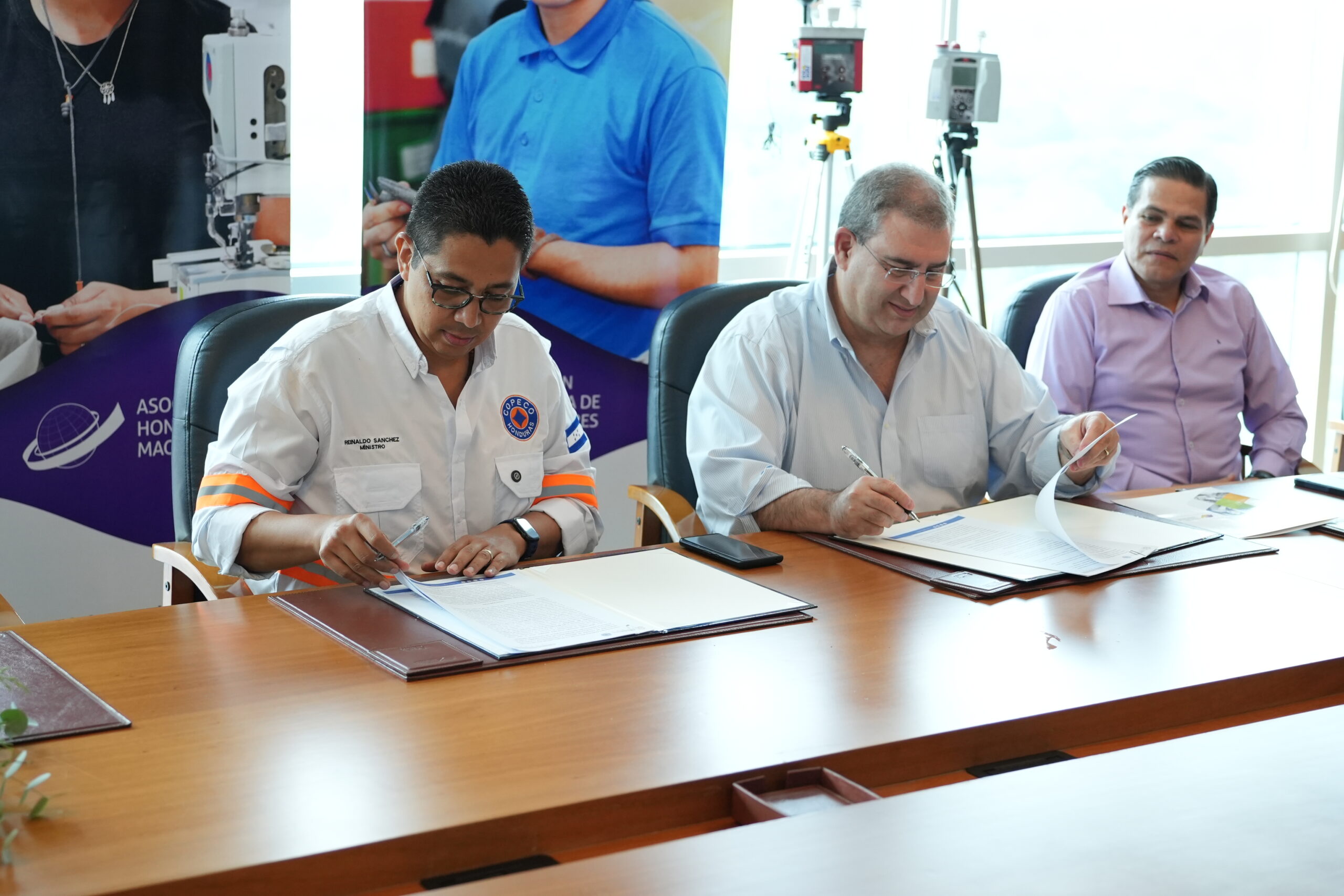
Training across key areas of workplace safety
Through PROCINCO, the SSO component provides occupational safety and health training across four broad areas, allowing companies to develop technical capabilities according to their workplace needs.
Disaster risk reduction, emergency plans, industrial brigades and competency-based emergency-response training.
Applied ergonomics, prevention of musculoskeletal injuries and hearing conservation.
Safety fundamentals, accident prevention and investigation, high-risk work and safe equipment operation.
Environmental-protection principles and implementation and management of good environmental practices.
Measuring workplace exposure conditions
Environmental hygiene studies support the identification and evaluation of physical and chemical conditions that may affect occupational health.
SSO training is based on Honduras' General Regulation for Preventive Measures of Occupational Accidents and Occupational Diseases and incorporates technical references from OSHA, NIOSH and NFPA.

National recognition of the SSO Unit
The Secretariat of Labor and Social Security certified the SSO Unit as a Specialized Provider of Occupational Safety and Health Prevention Services, making it the first organization in Honduras to receive this recognition.
The recognition supports the Unit's capacity to advise companies and provide environmental hygiene analyses under requirements established by the labor authority.
Industrial emergency brigade training
AHM's audiovisual archive preserves part of the development of industrial emergency-brigade training and practical response activities.
Historical audiovisual material documenting industrial emergency-brigade training and practical response activities.
Specialized initiatives developed over time
Technical programs and institutional partnerships extend SSO support into occupational health, ergonomics, workplace management, emergency response and organizational resilience.
This voluntary occupational safety and health self-management program promotes the establishment of workplace management systems based on applicable occupational safety and health requirements.
The SSO Unit provides technical assistance to member companies participating in the program.
Developed with the IHSS Rehabilitation Center, the program supports prevention of musculoskeletal injuries through education, exercise, posture awareness and back care.
The program consists of ten 45-minute sessions conducted within participating companies during working hours with internal instructors.
Its educational and exercise approach focuses on the cervical and lumbar spine, helping workers improve posture, reduce harmful habits and strengthen functional capacity.

SOLVE incorporates comprehensive health promotion into occupational safety and health management systems to support the long-term well-being of workers and workplaces.
Its approach addresses psychosocial risks, potential addictions and healthy lifestyle practices.
Cooperation with COPECO and other partners has strengthened the participation of private companies in disaster-risk reduction, emergency planning and response.
This work includes company contingency plans, workplace emergency committees, industrial emergency brigades and coordination within the national risk-management system.
Cooperation with the Honduras Fire Department supports joint activities related to human safety, fire prevention, emergency response and risk mitigation within member companies.
The collaboration also promotes compliance with applicable national fire-prevention requirements and technical exchange between both institutions.
AHM and the Bipartite Commission, with technical support from the ILO, developed the Ergonomic Risk Management Policy for Honduras' textile-manufacturing sector.
The accompanying methodology supports identification and assessment of ergonomic risks, formation of ergonomics committees, implementation of controls and continuous workplace improvement.
Developed during the COVID-19 period with support from ILO/ACTEMP, the Business Continuity Plan guide remains available as a technical resource for organizational resilience and emergency planning.
It addresses risk assessment, essential operations, protection and mitigation measures, response, recovery and review of continuity plans for emergency situations.
Need technical support for workplace safety and health?
Contact the SSO Unit for industrial safety assistance, environmental hygiene monitoring, emergency planning and response, training or occupational risk-prevention support.